Best Binocular Mounts for Astrophotography
By DeepField · 8 min read · Updated November 2026
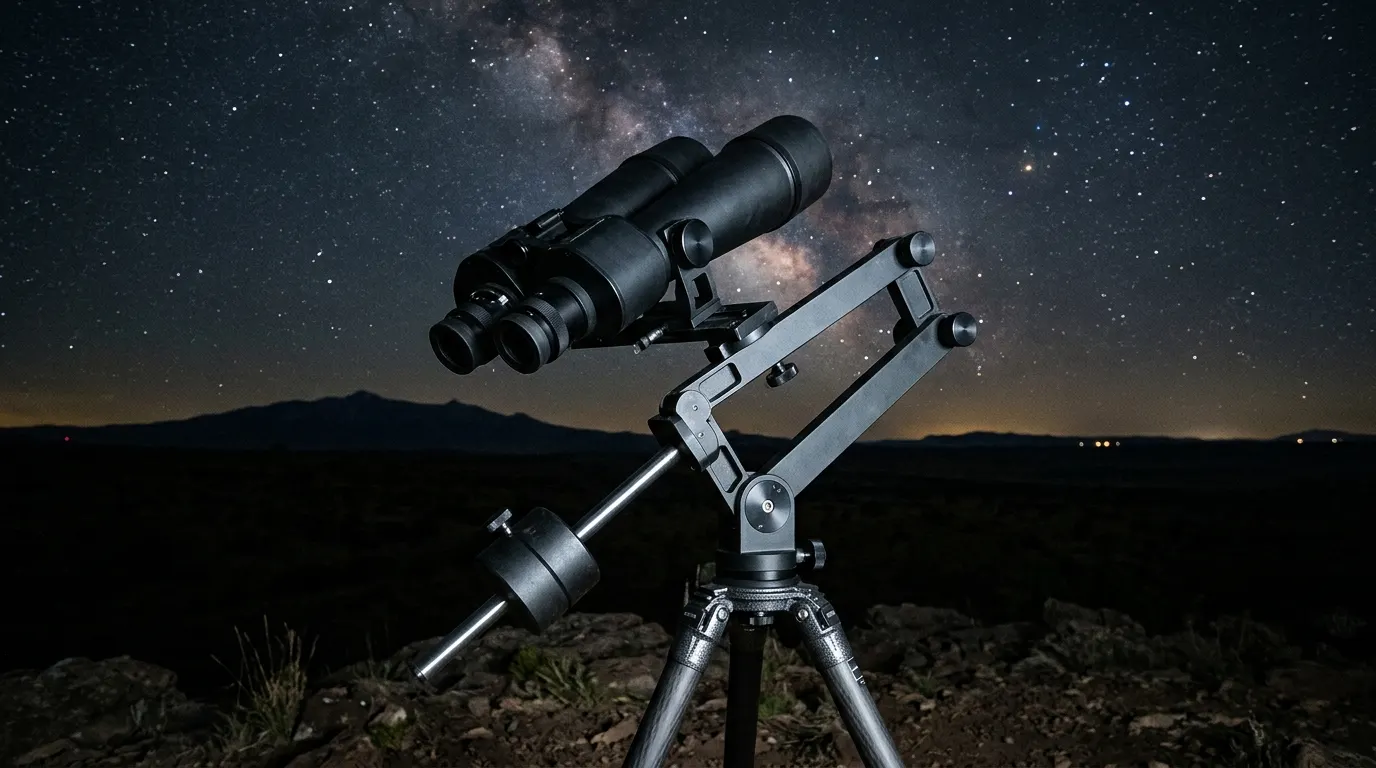
A binocular mount and an astrophotography mount solve different problems, and most advice blurs them. A true binocular mount holds large binoculars steady for your eyes, but it does not track the sky. A star tracker follows the sky for long exposures, but it puts the eyepieces in awkward positions for observing. This guide keeps those jobs separate. It names the dedicated binocular mounts worth shortlisting, even though DeepField does not sell them, then shows where a tracker like the iOptron SkyGuider Pro Camera Mount or Sky-Watcher Star Adventurer 2i Pro Pack fits if you want to photograph through one barrel. It also explains when a camera lens is the better answer.
Quick answer
The best binocular mount for most observers is a parallelogram design, such as Farpoint's, because it holds large binoculars steady and stays comfortable near the zenith. It does not track the sky. For imaging through binoculars, use an iOptron SkyGuider Pro tracker with 15x70 binoculars and a phone adapter, though a camera lens on that tracker produces better images.
This guide contains affiliate links. DeepField may earn a commission at no cost to you.
Which binocular mount should you actually buy?
Farpoint and Universal Astronomics are the first two brands to shortlist, because both build dedicated binocular mounts, while DeepField sells neither.
Farpoint builds a parallelogram binocular mount, the type we would choose first for large binoculars on a sturdy tripod. The UniMount from Universal Astronomics, sold through Company Seven, is an articulated parallelogram binocular mount. The Orion Paragon-Plus and Monster Parallelogram are also well known, but Orion Telescopes and Binoculars closed in 2024, so treat those as used-market finds.
We have not bench-tested these mounts, and availability changes, so confirm the current model and its binocular weight limit on the maker's spec sheet before you order. Compare that limit against the weight of your binoculars plus any adapter.
If your goal is tracked imaging rather than observing, none of these mounts will do that job. Skip ahead to the tracker section, where the iOptron SkyGuider Pro Camera Mount is our pick for that narrower use.

iOptron SkyGuider Pro Camera Mount
An 11 lb payload tracker with an illuminated polar scope, fine RA adjustment knob, and a declination bracket that allows precise framing corrections.
Why pick a parallelogram mount over a plain tripod?
Farpoint-style parallelogram mounts win because a counterweighted arm lets you raise or lower large binoculars without losing the target, keeps tripod legs out of your way near the zenith, and lets people of different heights share the view.
Hand tremor is the problem any mount solves first. Binocular observers commonly treat about 10x as the point where shake starts to hide detail, which is a community rule of thumb rather than a manufacturer spec. A plain tripod removes the shake, but it forces you to crouch under the binoculars as your target climbs, and that is where a parallelogram arm earns its bulk.
The trade-offs are size and weight. A parallelogram arm needs a heavy tripod, takes up real space in the car, and adds setup time. It also has no motor, so stars still drift through the field. That is fine for your eyes and a dealbreaker for long exposures.
What is the cheapest way to mount binoculars for the Moon?
Celestron sells the simple route, an L-shaped binocular tripod adapter that threads into the socket on many central-hinge binoculars and attaches to the photo tripod you already own, which is enough for steady Moon viewing and phone snapshots.
Check your binoculars before ordering. Many porro prism models hide a threaded socket under a small cap at the front of the central hinge, and it takes the 1/4-20 thread defined for photo tripods in ISO 1222. Many compact models have no socket at all. Very large models such as the Celestron SkyMaster 25x100 carry their own mounting hardware, so an L-adapter may be unnecessary.
Test the tripod head too. Many video and pan heads stop short of pointing straight up, so check the tilt range if you plan to look high in the sky. The Moon is the right first target for this setup, because it is bright enough for very short phone exposures and needs no tracking at all.
Can you take real astrophotos through binoculars?
Sky-Watcher and iOptron star trackers make it possible to image through one binocular barrel with a phone, but the result is a learning project and not a match for a camera with a telephoto lens on the same tracker.
The reason you need tracking is magnification. Under the standard afocal formula, equivalent focal length is the binocular magnification times the phone lens focal length, so 15x binoculars and a 26 mm equivalent main phone camera give roughly 390 mm equivalent. The 500 rule, a rule of thumb among photographers, allows only about one second before stars visibly trail at that length, so faint targets need a tracker.
With a polar-aligned tracker, start around 15 seconds per frame and check the corners at full zoom. That figure is our suggested starting point, not a tested limit, because your result depends on polar alignment and on how well the phone stays centered on the eyepiece. Shoot RAW if your camera app allows it, and stack the frames in free software such as Siril.
Keep expectations realistic. Binoculars are designed for the eye, so stars soften toward the edge of the field and bright stars can show color fringing, and a phone sensor is small. The Pleiades and the Orion Nebula are good first targets. If you already own a DSLR or mirrorless body, put a telephoto lens on the tracker instead.
iOptron SkyGuider Pro Camera Mount
An 11 lb payload tracker with an illuminated polar scope, fine RA adjustment knob, and a declination bracket that allows precise framing corrections.
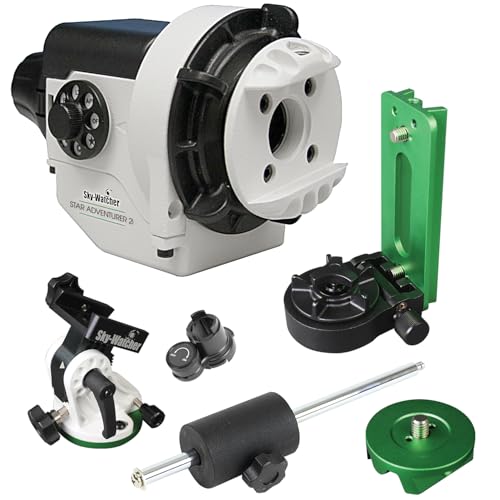
Sky-Watcher Star Adventurer 2i Pro Pack
An 11 lb payload star tracker that mounts to any photo tripod and provides accurate RA tracking for wide-field and telephoto astrophotography on the road.
Which star tracker works best with binoculars?
iOptron SkyGuider Pro is our pick for binocular imaging because its declination bracket makes small framing corrections easier, and the Sky-Watcher Star Adventurer 2i is the alternative for anyone who prefers Wi-Fi control through the Star Adventurer mini Console app.
These are trackers, not binocular mounts, and we do not rank them as observing mounts. The eyepieces rotate with the tracking axis, so they can end up at angles that are awkward for your eyes. Buy one only if the camera side of this hobby is the point.
The iOptron SkyGuider Pro Camera Mount is listed at $350 to $420 and the Sky-Watcher Star Adventurer 2i Pro Pack at $550 to $650 on our product pages, so the iOptron is also the cheaper way in. Our catalog lists both at 11 lbs of payload. Prices move, so check the current listing before you buy.
Do not plan around the full 11 lbs. This site uses a working rule of 50 to 60 percent of rated payload, which leaves about 5.5 to 6.6 lbs. Celestron publishes roughly 3 lbs for its SkyMaster 15x70, which leaves room for a ball head and phone adapter. Its SkyMaster 25x100 is roughly 8.75 lbs on the same spec sheets, which is over that working limit before you add anything else, so leave giant binoculars off a small tracker.
You will also need a sturdy photo tripod, a ball head, and a phone adapter that clamps to the eyepiece. Balance the binoculars and phone around the tracking axis as closely as you can, and recheck focus after the phone is attached, because its weight can shift the eyepiece.
iOptron SkyGuider Pro Camera Mount
An 11 lb payload tracker with an illuminated polar scope, fine RA adjustment knob, and a declination bracket that allows precise framing corrections.
Sky-Watcher Star Adventurer 2i Pro Pack
An 11 lb payload star tracker that mounts to any photo tripod and provides accurate RA tracking for wide-field and telephoto astrophotography on the road.
Do binoculars need dew control?
The Pegasus Astro DewZap is a two-channel controller that fits binoculars well, because a pair of objectives is two separate lenses to keep above the dew point, and one heater strip per barrel covers them.
Binocular objectives fog for the same reason telescope lenses do: on a clear night the glass cools below the dew point. A pair of Dew-Not Dew Heater Strips (Various Sizes) is the economical start. Measure the outside circumference of each barrel near the objective rather than going by its aperture, and confirm the strip length before ordering.
The Pegasus Astro DewZap Dual-Channel Dew Controller gives you two PWM channels with per-channel adjustment, one for each barrel. The Dew-Buster Dew Controller is another option, but check its channel count and control style on the current listing before you buy. If you only image through one barrel, one channel is enough, but heat both if you also observe through the pair.
Power demand is modest. Elsewhere on this site we estimate roughly three to seven watts for a single mid-sized heater at 50 percent power, and strips this small should sit at or below that range. Measure your own draw if you plan to run from a small battery. Keep your breath away from the eyepieces as well, since no objective heater helps there.

Dew-Not Dew Heater Strips (Various Sizes)
An affordable dew heater strip range with velcro attachment and a standard RCA phono connector, compatible with all major dew controllers and sized for objectives from 1.25 inches to 12 inches.
Dew-Buster Dew Controller
A dew heater controller from Dew-Buster. Check the current listing for channel count and control style before you buy.
Pegasus Astro DewZap Dual-Channel Dew Controller
A compact two-channel PWM dew controller from Pegasus Astro with per-channel adjustment knobs and the same build quality as the DewMaster at a lower price.
Should you buy a GoTo equatorial mount for binoculars?
Sky-Watcher, ZWO, iOptron, and Celestron GoTo equatorial mounts are the wrong purchase for binoculars alone, because they add cost, weight, and awkward eyepiece angles while solving a deep-sky telescope problem binocular owners do not have.
The least expensive GoTo mount in our catalog is listed at $900 to $1,100, and the popular mid-payload models run well above that. That money only makes sense if you plan to image through a small telescope. In that case, choose the mount for the telescope using our equatorial mount guide, and treat any binocular use as a bonus.
Which setup should you pick?
Farpoint-style parallelogram mounts suit dedicated observers, a Celestron-style tripod adapter suits casual Moon viewing, and an iOptron SkyGuider Pro suits imagers, though a camera lens on that tracker will outperform binoculars.
Start with the cheapest step that answers your question. Try an L-adapter on a tripod you already own, and upgrade to a parallelogram mount if you find yourself observing often with binoculars of 15x or more. Add the iOptron SkyGuider Pro Camera Mount only when photographing the sky is the goal, and keep your existing binoculars for the first test before spending more on optics.
iOptron SkyGuider Pro Camera Mount
An 11 lb payload tracker with an illuminated polar scope, fine RA adjustment knob, and a declination bracket that allows precise framing corrections.
Featured in this guide
iOptron SkyGuider Pro Camera Mount
An 11 lb payload tracker with an illuminated polar scope, fine RA adjustment knob, and a declination bracket that allows precise framing corrections.
Sky-Watcher Star Adventurer 2i Pro Pack
An 11 lb payload star tracker that mounts to any photo tripod and provides accurate RA tracking for wide-field and telephoto astrophotography on the road.
Pegasus Astro DewZap Dual-Channel Dew Controller
A compact two-channel PWM dew controller from Pegasus Astro with per-channel adjustment knobs and the same build quality as the DewMaster at a lower price.
Dew-Buster Dew Controller
A dew heater controller from Dew-Buster. Check the current listing for channel count and control style before you buy.
Dew-Not Dew Heater Strips (Various Sizes)
An affordable dew heater strip range with velcro attachment and a standard RCA phono connector, compatible with all major dew controllers and sized for objectives from 1.25 inches to 12 inches.
Keep reading
Related comparisons
Related roundups
FAQ
Frequently asked questions
What is the best type of binocular mount for astronomy?+
A parallelogram mount is the best type for large binoculars used for observing. Its counterweighted arm lets you change height without losing the target, keeps the tripod legs clear when you look high in the sky, and suits observers of different heights. It does not track the sky, so it is an observing tool rather than an imaging mount.
Can a star tracker work as a binocular mount?+
Only for imaging. A tracker such as the iOptron SkyGuider Pro can carry 15x70 binoculars and a phone adapter for tracked exposures through one barrel. It is poor for observing, because the eyepieces rotate with the tracking axis and can end up at awkward angles. Buy a dedicated binocular mount if your main goal is looking through the binoculars.
Do I need a mount for 10x50 binoculars?+
Not necessarily. Many observers hand-hold 10x50 binoculars comfortably, though a tripod adapter still shows noticeably more detail on the Moon and on star clusters because it removes shake. A parallelogram mount is usually more than these small binoculars need, so try an inexpensive L-adapter on a tripod you already own first.
Are binoculars or a camera lens better for astrophotography?+
A camera lens is better. It sits directly on a larger sensor, gives you control over focus and exposure, and avoids the extra optics and alignment problems of shooting through an eyepiece. Binocular imaging is worthwhile as an inexpensive experiment if you already own the binoculars and a phone, but it should not drive a major purchase.
How heavy can my binoculars be on a star tracker?+
Our catalog lists both the iOptron SkyGuider Pro and the Sky-Watcher Star Adventurer 2i at 11 lbs of payload, and we suggest staying at 50 to 60 percent of that rating, or about 5.5 to 6.6 lbs. Binoculars around 3 lbs leave room for a ball head and phone adapter. Weigh the full assembly before you rely on it.