Astrophotography Statistics 2026: 27 Key Data Points
By DeepField · 8 min read · Updated June 2026
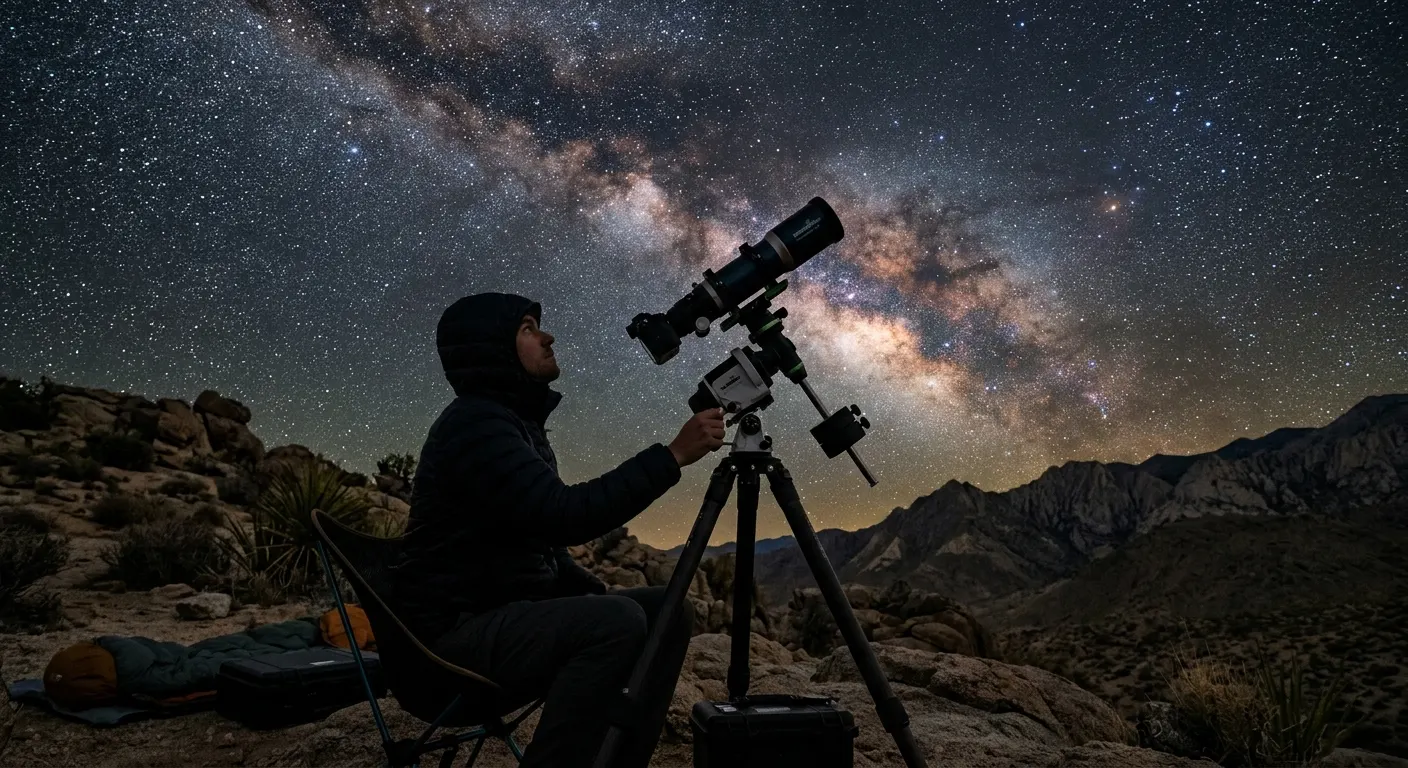
Astrophotography sits at the intersection of a growing hobby market and a shrinking resource: the dark sky itself. This page collects 27 of the most useful, fully sourced statistics on the night sky and the gear used to capture it: how fast light pollution is erasing the stars, how large the telescope, astro-camera, and smart-telescope markets have become, and the scale of public astronomy moments like the 2024 total solar eclipse. Every figure below names its source and year so you can cite it with confidence. The data draws on peer-reviewed studies in Science and Science Advances, NASA, and major market researchers.
Quick answer
About 83 percent of the world and nearly 80 percent of North Americans live under skies too bright for the Milky Way, with brightness increasing roughly 9.6 percent yearly. The global telescope market is around 1.27 billion dollars, the astrophotography camera market is growing 8 percent a year, and the 2024 total solar eclipse drew over 30 million people.
This guide contains affiliate links. DeepField may earn a commission at no cost to you.
Light pollution: the disappearing night sky
The single biggest constraint on astrophotography is artificial skyglow, and it is widespread. Based on the New World Atlas of Artificial Night Sky Brightness (Falchi et al., Science Advances), as reported by MIT Technology Review, about 83 percent of the world population lives under light-polluted skies, and more than 99 percent of people in the US and Europe do.
The practical effect is the loss of the Milky Way. The same atlas, via MIT Technology Review, found that nearly 80 percent of North Americans and 60 percent of Europeans can no longer see the Milky Way from where they live.
It is getting worse quickly. A Globe at Night study (Kyba et al., Science), as reported by Phys.org, found global night sky brightness increasing about 9.6 percent per year between 2011 and 2022, with North America rising 10.4 percent per year and Europe 6.5 percent per year.
That growth rate has a stark consequence. The same Phys.org coverage notes that at the measured pace, a child born where 250 stars are visible would see only about 100 of them by their 18th birthday. The study drew on 51,351 citizen-science naked-eye observations from 19,262 locations.
The telescope and imaging-gear market
The hardware side of the hobby is a steady, growing market. MarketDataForecast sizes the global telescope market at 1.27 billion dollars in 2025, projecting growth to 1.44 billion dollars by 2034. Business Research Insights tracks a faster-growing astronomical telescope segment at a 6.63 percent CAGR through 2035.
Cameras built specifically for the night sky are growing faster than telescopes overall. DataHorizzon Research sizes the astrophotography camera market at 300 million dollars in 2023, projecting it to reach 500 million dollars by 2033 at an 8 percent compound annual growth rate.
Smart, app-driven telescopes are the fastest-moving slice. Verified Market Reports values the smart telescope market at 221 million dollars in 2025, growing to 360 million dollars by 2032 at a 7.28 percent CAGR. For imagers working from light-polluted backyards, much of the spend goes to enabling accessories like the narrowband Optolong L-eXtreme Dual-Band Filter (7 nm) that cut through skyglow.

Optolong L-eXtreme Dual-Band Filter (7 nm)
A 7 nm dual-band narrowband filter passing H-alpha and OIII designed specifically for one-shot-color cameras under heavy light pollution. One of the most popular emission-nebula filters for OSC imagers.
Public astronomy: the 2024 total solar eclipse
Nothing pulls people toward the sky like an eclipse. Clarkston Consulting reports that more than 30 million Americans lived within the path of totality for the April 8, 2024 total solar eclipse, and estimated its US economic impact at about 6 billion dollars, with eclipse-glasses sales topping 100 million dollars.
The digital reach was enormous too. NASA reported that its live broadcast of the 2024 eclipse peaked at 1,458,212 concurrent viewers, and that NASA distributed 2.05 million eclipse glasses for the event.
Astrotourism and organized astronomy
As skies darken near cities, people travel to find dark ones. MarketIntelo sizes the stargazing or astrotourism market at 1.82 billion dollars in 2025, projecting growth to 4.57 billion dollars by 2034.
Organized amateur astronomy remains a meaningful community. The Royal Astronomical Society reports more than 4,000 fellows, and the US Astronomical League lists over 330 affiliated astronomy-club organizations.
Sources
Falchi et al., New World Atlas of Artificial Night Sky Brightness, Science Advances, 2016, as reported by MIT Technology Review.
Kyba et al., Globe at Night skyglow study, Science, 2023, as reported by Phys.org.
MarketDataForecast, Telescope Market, 2025. Business Research Insights, Astronomical Telescope Market, 2026.
DataHorizzon Research, Astrophotography Cameras Market, 2023. Verified Market Reports, Smart Telescope Market, 2025. MarketIntelo, Stargazing Tourism Market, 2025.
Clarkston Consulting, Economic Impacts of the 2024 Solar Eclipse, 2024. NASA Science, Looking Back on Looking Up: The 2024 Total Solar Eclipse, 2024.
Royal Astronomical Society and Astronomical League membership figures via Wikipedia.
Featured in this guide
Optolong L-eXtreme Dual-Band Filter (7 nm)
A 7 nm dual-band narrowband filter passing H-alpha and OIII designed specifically for one-shot-color cameras under heavy light pollution. One of the most popular emission-nebula filters for OSC imagers.
Keep reading
Related comparisons
Related roundups
FAQ
Frequently asked questions
How much of the world cannot see the Milky Way?+
About 83 percent of the world population lives under light-polluted skies, and nearly 80 percent of North Americans and 60 percent of Europeans can no longer see the Milky Way from where they live, according to the New World Atlas of Artificial Night Sky Brightness as reported by MIT Technology Review.
How fast is light pollution getting worse?+
Global night sky brightness is increasing about 9.6 percent per year, with North America rising 10.4 percent and Europe 6.5 percent per year between 2011 and 2022, according to a Globe at Night study published in Science. At that pace, a sky with 250 visible stars would show only about 100 within 18 years.
How big is the telescope market?+
MarketDataForecast sizes the global telescope market at about 1.27 billion dollars in 2025, projected to reach 1.44 billion by 2034. The astrophotography camera market is smaller but faster-growing, at about 300 million dollars in 2023 and an 8 percent annual growth rate.
Is astrophotography a growing hobby?+
The supporting markets are all growing. The astrophotography camera market is growing at 8 percent a year, the smart telescope market at 7.28 percent, and the broader astrotourism market is projected to more than double to 4.57 billion dollars by 2034. Major events like eclipses keep pulling in new participants.
How many people watched the 2024 total solar eclipse?+
More than 30 million Americans lived within the path of totality, and NASA reports its live broadcast peaked at 1,458,212 concurrent viewers. NASA distributed 2.05 million eclipse glasses, and the event had an estimated US economic impact of about 6 billion dollars.